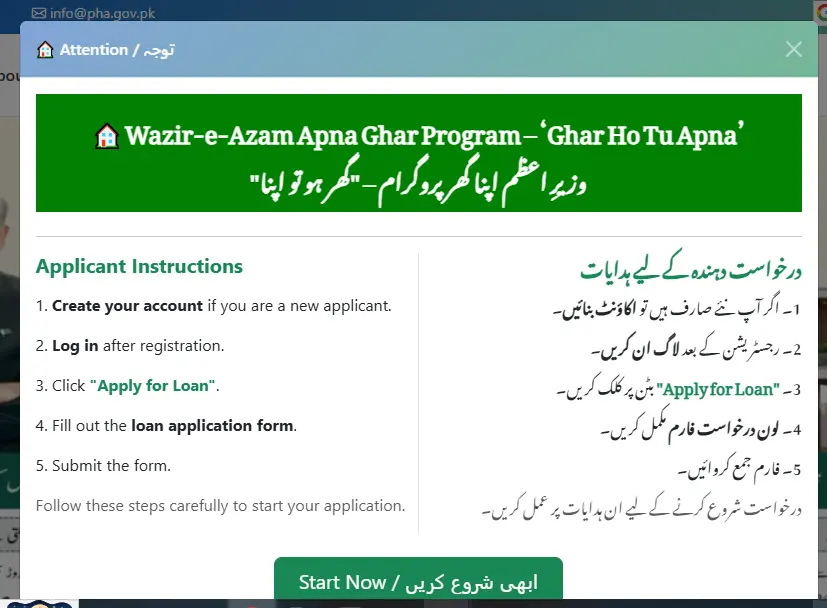
The 30-second answer: If you live in Punjab and earn less than Rs 60,000 per month with a small plot of land, choose Apni Chhat Apna Ghar (ACAG), it's interest-free. If you live anywhere in Pakistan and have a stable salary or business income to buy or build a home up to 10 marla, choose the federal PM Apna Ghar Programme, it offers up to Rs 10 million at 5% markup. Both are open right now. Many Punjab families qualify for both and apply to both.
If the names sound nearly identical, it's because they are, and the confusion is costing thousands of families the wrong application or the wrong portal. Apna Ghar literally means "your own home" in Urdu, and the federal and Punjab governments have each used the phrase for completely different schemes. One is a federal middle-income mortgage programme launched on 30 April 2026 by Prime Minister Shehbaz Sharif. The other is a Punjab-only zero-interest loan scheme launched earlier by Chief Minister Maryam Nawaz that has already disbursed Rs 164.66 billion to over 1 million families with a 99% recovery rate.
This guide cuts through the confusion with a head-to-head breakdown. By the end, you'll know exactly which one applies to your situation, whether you should apply to both, and what each scheme actually delivers in your hands.
Quick Comparison: At a Glance
| Feature | PM Apna Ghar Programme (Federal) | Apni Chhat Apna Ghar (Punjab) |
|---|---|---|
| Launched By | PM Shehbaz Sharif | CM Maryam Nawaz Sharif |
| Launch Date | 30 April 2026 | 2024 (active, expanded 2026) |
| Coverage Area | All Pakistan + GB + AJK | Punjab only |
| Maximum Loan | Rs 10 million | Rs 1.5 million (15 lakh) |
| Loan Slabs | Rs 2.5M / 5M / 7.5M / 10M | Single slab up to Rs 1.5M |
| Markup Rate | 5% fixed (10 yrs), then KIBOR+3% | 0%, fully interest-free |
| Repayment Period | Up to 20 years | 5,9 years |
| Min Equity from Applicant | 10% of property value | None (you already own the land) |
| Income Limit | None, needs verifiable income | Below Rs 60,000/month household |
| PMT Score Required | Not required | 60 or below in NSER |
| Property Size Cap | 10 marla home / 1,500 sq ft flat | 5 marla urban / 10 marla rural |
| Land Requirement | Not needed (loan can buy plot+construct) | Must already own the plot |
| Application Portal | apnaghar.gov.pk | acag.punjab.gov.pk |
| Approval Timeline | 15 working days | 6,8 weeks |
| Total Programme Budget | Rs 3.2 trillion | ~Rs 200 billion (cumulative) |
| Target Beneficiaries | 500,000 homes (4 yrs) | 160,000 homes (by June 2026) |
| Disbursement Method | To seller (purchase) or in tranches (construction) | In construction-linked tranches |
| Best For | Salaried/professional middle-income | Low-income asset-poor families |
What Each Scheme Is, Plain Language
PM Apna Ghar Programme, The Federal Mortgage
The Prime Minister's Apna Ghar Programme is a markup subsidy and risk-sharing scheme notified by the State Bank of Pakistan. In simple terms, the federal government guarantees part of the bank's risk so banks can offer 20-year mortgages at a fixed 5% markup, far below the commercial rate of 18,22%.
This is bank financing, not a government grant. You apply through a participating bank (Allied Bank, Bank Alfalah, Bank of Punjab, HBFC, Meezan Bank, Bank AL Habib), they verify your income and the property, and they disburse the loan to you. The federal government subsidises the markup difference for the first 10 years.
The programme is meant for people who earn enough to qualify for a mortgage but can't afford commercial rates, typical middle-income households: junior officers, school teachers, small business owners, IT professionals, doctors in early career.
Apni Chhat Apna Ghar, The Punjab Soft Loan
ACAG is a different beast. It is a direct provincial soft loan, the Punjab Government takes the loan from the State Bank under a special arrangement, then on-lends it to qualifying families at zero interest, with the government absorbing 60% of the project cost as subsidy.
This is not a bank product, it is a Punjab Government social welfare programme implemented through PHATA (Punjab Housing & Town Planning Agency). You apply on the provincial portal, your eligibility is verified against the National Socio-Economic Registry (NSER) and your PMT score, and the loan is disbursed in construction tranches as you build.
The programme is meant for families who cannot qualify for any commercial mortgage, daily wage earners, widows, small farmers, low-grade government employees. The Rs 14,000/month installment is set deliberately equivalent to typical urban rent so the family pays no extra burden, but at the end of seven years they own a home instead of a rent receipt.
Eligibility, Compared Side by Side
PM Apna Ghar Programme
You qualify for the federal scheme if:
- You hold a valid CNIC and are a resident Pakistani citizen (or NRP via Roshan Apna Ghar)
- You are aged 25,60 (salaried) or 25,65 (self-employed) at loan maturity
- You have stable, verifiable income, salary, business, or professional earnings
- You can produce 6 months of salary slips or 12 months of bank statements
- You have no record of loan default with any bank
- You are a first-time homeowner (no residential property in your name in Pakistan)
- You can put down 10% equity, between Rs 250,000 and Rs 1,000,000 depending on your loan slab
There is no income ceiling for the federal scheme, even higher-middle-income earners can apply, as long as the property is within the size cap and they meet other criteria.
Apni Chhat Apna Ghar (ACAG)
You qualify for the Punjab scheme if:
- You are a permanent resident of Punjab (per CNIC)
- You are the head of family per NADRA records
- Your monthly household income is below Rs 60,000 (some BoP-tied components require under Rs 50,000)
- Your PMT score is 60 or below in the NSER database
- You already own a plot of land, up to 5 marla in an urban area or up to 10 marla in a rural area
- You are not a bank defaulter
- You have no criminal record, no FIR or court case against you
- You do not already own a constructed house in your name
Unlike the federal scheme, ACAG has a strict income ceiling and a poverty-score requirement. It is means-tested by design, it exists to reach families that the banking system has historically excluded.
Cost & Affordability, Real Math
This is where the two schemes look very different in your monthly budget.
PM Apna Ghar (Federal), Real Monthly Installments
| Loan Amount | Monthly Installment (Yrs 1,10 at 5%) | Total Repaid Over 20 Years |
|---|---|---|
| Rs 2,500,000 | Rs 16,499 | ~Rs 3.96 million |
| Rs 5,000,000 | Rs 32,997 | ~Rs 7.92 million |
| Rs 7,500,000 | Rs 49,497 | ~Rs 11.88 million |
| Rs 10,000,000 | Rs 65,996 | ~Rs 15.84 million |
Note: Your installment for years 11,20 will be reset based on prevailing 1-year KIBOR + 3% at that time, which could be lower or higher than the initial 5%.
Apni Chhat Apna Ghar (Punjab), Real Monthly Installments
| Loan Amount | Monthly Installment | Total Repaid |
|---|---|---|
| Rs 1,500,000 (max) | Rs 14,000,26,000 (depending on tenure) | Rs 1.5 million flat (no interest) |
Most ACAG approvals are in the 7-year, Rs 14,000 monthly installment range. A few approvals at the longer 9-year tenure or bigger families' upgraded approvals come in at around Rs 26,000.
Critical difference: With ACAG, you repay only the principal. The Rs 1.5 million you borrowed is exactly what you pay back over time. With the federal scheme, you repay principal plus markup, on a Rs 2.5 million loan, that's roughly Rs 1.46 million extra over 20 years.
What Each Loan Can Be Used For
| Use Case | PM Apna Ghar (Federal) | Apni Chhat Apna Ghar (Punjab) |
|---|---|---|
| Buy a constructed house | ✅ Yes | ❌ No |
| Buy a flat/apartment | ✅ Yes (up to 1,500 sq ft) | ❌ No |
| Buy a plot + construction | ✅ Yes | ❌ No |
| Build a house on land you own | ✅ Yes | ✅ Yes |
| Add a floor to existing house | ❌ No | ✅ Yes (joint families update, Jan 2026) |
| Renovation only | ❌ No | ❌ No |
| Plot purchase only (no construction) | ❌ No | ❌ No |
The 2026 expansion of ACAG to include joint families is significant, if your extended family lives in one house, ACAG can now finance adding floors or rooms. The federal scheme does not currently fund add-ons.
Documentation, What Each Scheme Demands
Documents Required for PM Apna Ghar (Federal)
- CNIC (and spouse's CNIC if married)
- 6 months' salary slips (salaried) OR 12 months' bank statements (self-employed)
- Employer letter (salaried) OR business registration & NTN (self-employed)
- Property documents (sale deed / registry of property being purchased or constructed)
- Approved building plan (for construction loans)
- Equity proof (bank statement showing 10% amount)
- 2,4 passport-sized photos
- Reference letters (one personal, one professional)
Documents Required for Apni Chhat Apna Ghar (Punjab)
- CNIC (and spouse's CNIC if married)
- B-Form for children under 18
- Property document of your existing plot (Fard / Registry / Allotment)
- Possession proof (Patwari letter)
- Income proof (salary slip OR self-declaration)
- Affidavit on Rs 200 e-stamp paper (no other property in your name)
- 2,4 passport-sized photos
- NSER registration proof (PMT score below 60)
The federal scheme requires stronger income proof and equity. The Punjab scheme requires NSER/PMT verification. They genuinely test different things.
Approval Speed, Who's Faster
The Prime Minister has personally mandated banks to approve PM Apna Ghar applications within 15 working days of submission. Banks that fail this benchmark face government review, and top performers get national awards on 14 August 2026.
ACAG verification, by contrast, takes 6,8 weeks because every application goes through PHATA field verification (a Patwari visits your plot), NSER cross-check, and BISP database matching. The trade-off is that ACAG's verification is much deeper, which is why its 99% repayment recovery rate has held up.
| Stage | PM Apna Ghar (Federal) | ACAG (Punjab) |
|---|---|---|
| Form submission | Same day | Same day |
| Document verification | Days 1,5 | Weeks 1,2 |
| Field/property check | Days 5,10 | Weeks 2,4 |
| Eligibility cross-check | Done at bank | Weeks 4,6 (NSER + BISP) |
| Final approval | Day 15 | Weeks 6,8 |
| First disbursement | Day 16+ | After construction starts |
Track Record, Who's Actually Delivering
This is where ACAG has a real story to tell. As of January 2026, the Punjab scheme had achieved:
- 1.88 million users registered on the portal
- 1.06 million applicants in the verification queue
- 67,197 homes completed
- 53,843 homes under construction
- Rs 164.66 billion disbursed in loans
- 99% recovery rate on instalments, exceptional for any housing programme globally
- Target raised to 160,000 homes by June 2026
The federal PM Apna Ghar Programme has just launched. Year-1 target is 50,000 homes with Rs 321 billion allocated. The first cheques were distributed at the launch ceremony on 30 April 2026. We won't have meaningful performance data until Q3 2026.
What this tells you: ACAG is a proven, working programme with a track record. The federal scheme is brand new and ambitious but unproven. If you qualify for both, ACAG carries less execution risk, you can be confident the loan will actually disburse.
Real-World Decision Scenarios
To make this practical, here are five common situations and the right answer for each:
Scenario 1: "I'm a school teacher in Multan earning Rs 55,000/month. I own a 4-marla plot."
→ Apply for ACAG first. Your income is below the Rs 60,000 ceiling, you own a qualifying plot, and a zero-interest Rs 1.5M loan will let you build a basic 3-bedroom house at Rs 14,000/month, almost what you currently pay in rent. The federal scheme is overkill for your need.
Scenario 2: "I'm an IT professional in Karachi earning Rs 200,000/month. I want to buy a 5-marla house in Bahria Town."
→ Apply for PM Apna Ghar Programme. You're outside Punjab, your income is well above the ACAG ceiling, and you need a real mortgage to buy a constructed house. A Rs 5M loan at 5% markup (Rs 32,997/month) is your route.
Scenario 3: "I'm a daily-wage worker in Bahawalpur with no land at all."
→ Apply for Apni Zameen Apna Ghar (the AZAG sister scheme) first. Get a free 3-marla plot through the Punjab balloting. Once you have the plot, you can apply for ACAG to build the house. The federal scheme requires equity you don't have.
Scenario 4: "I'm a small business owner in Rawalpindi earning Rs 80,000/month with a 5-marla plot."
→ You qualify for PM Apna Ghar but not ACAG. Your income exceeds the Rs 60,000 ACAG ceiling. Apply for the federal scheme, a Rs 2.5M loan at Rs 16,499/month (lower than your current rent) is a strong fit.
Scenario 5: "I live in Lahore with my brother's family in a joint household. We need to add another floor."
→ Apply for ACAG (2026 expanded version). The Punjab Government opened ACAG to joint families in January 2026 specifically for floor/room additions. The federal scheme does not finance home expansions.
Can You Apply for Both?
Yes, but with conditions.
If you qualify for both, you can register on both portals and submit both applications. This is increasingly common among Punjab residents who want maximum flexibility. However:
- You can only avail one final disbursement. The system flags duplicate beneficiaries during cross-verification.
- Many applicants apply for both, then accept whichever approves first.
- If approved by both, you must withdraw from one before signing the loan agreement of the other.
- You cannot stack the loans (use Rs 1.5M from ACAG plus Rs 10M from federal). Programme rules treat them as alternatives.
The reason people apply to both is simple: ACAG verification takes 6,8 weeks while federal takes 15 working days. If you're in a hurry, the federal route closes faster, but if cost matters most, ACAG is interest-free.
What Each Scheme Won't Tell You Upfront
After studying official documentation, news reports, and applicant complaints, here are the realities each scheme's marketing doesn't emphasize:
PM Apna Ghar, Hidden Considerations
- The 5% markup is fixed only for 10 years. After that, your installment can rise sharply if KIBOR is high.
- Banks have their own internal credit-scoring layered on top of programme eligibility, even if you qualify on paper, your bank may decline.
- For loans above Rs 5 million, you pay for a third-party valuer (typically Rs 25,000,Rs 50,000) before approval.
- The 10% equity is non-negotiable. Many applicants don't realize this when they start the application.
ACAG, Hidden Considerations
- The 60% government subsidy is on the project cost, not always equivalent to a Rs 1.5M loan write-down. Read the loan terms carefully.
- PHATA can withdraw the loan if construction milestones are missed.
- The Rs 14,000 installment is often described as starting "after a 3-month grace period", meaning your first payment is in month 4, not month 1.
- Your plot must be PLRA-verified. If your registry has errors, fixing them can take 2,4 weeks before your application can move forward.
Frequently Asked Questions
PM Apna Ghar is a federal mortgage scheme for all Pakistanis offering up to Rs 10 million at 5% markup over 20 years. Apni Chhat Apna Ghar is a Punjab-only soft loan offering up to Rs 1.5 million at zero interest for low-income families with a PMT score of 60 or below. They serve different income groups and have different eligibility rules.
Yes, if you qualify for both. Many Punjab residents apply to both to maximise their chances. However, you can only avail one final loan disbursement, the second application must be withdrawn before signing the loan agreement.
Only Apni Chhat Apna Ghar (ACAG) is fully interest-free. The PM Apna Ghar Programme has a 5% fixed markup for the first 10 years, then transitions to KIBOR + 3% for the remaining tenure.
PM Apna Ghar Programme has a much higher cap (Rs 10 million) compared to ACAG's Rs 1.5 million. The federal scheme offers four loan slabs: Rs 2.5M, Rs 5M, Rs 7.5M, and Rs 10M.
You can only apply for the PM Apna Ghar Programme (federal). ACAG is restricted to Punjab residents whose CNIC shows a Punjab address. NRPs outside Pakistan can apply for the federal scheme through Roshan Apna Ghar.
The PM Apna Ghar Programme has a 15-working-day approval mandate, making it significantly faster. ACAG takes 6,8 weeks because of NSER and PHATA field verification.
Neither scheme directly. The PM Apna Ghar Programme can finance plot purchase + construction together, but you need 10% equity. If you have no land and very low income, apply for Apni Zameen Apna Ghar (AZAG) first to get a free 3-marla plot, then apply for ACAG to build on it.
ACAG has fewer document requirements for the income side because PMT verification is automated through NSER. The federal scheme demands stronger income proof, equity proof, and credit history, typical of any commercial mortgage.
For PM Apna Ghar, the participating bank pursues normal recovery, the property can be foreclosed under standard banking law. For ACAG, PHATA can suspend further disbursements and ultimately recover the loan, but the programme's track record (99% recovery) shows defaults are rare because the installment is structured below typical rent.
For low-income applicants in Punjab, ACAG is more reachable, it is designed to approve people the banks would normally reject. For middle-income applicants with verifiable salary/business income, PM Apna Ghar is more reachable because eligibility is income-based, not poverty-based.
No. They are designed to coexist and serve different income segments. ACAG continues to operate independently of the federal scheme. CM Maryam Nawaz has confirmed continued provincial funding for ACAG through 2027 and beyond.
Apni Chhat Apna Ghar (ACAG) provides a Rs 1.5M interest-free construction loan to families who already own a plot. Apni Zameen Apna Ghar (AZAG) provides a free 3-marla residential plot to landless families. Many beneficiaries first get a plot through AZAG, then apply for ACAG to build their house.
Final Recommendation
If you live in Punjab, are below the Rs 60,000 income line, and own a small plot, ACAG is the obvious choice. Zero interest, proven track record, and a Rs 14,000 monthly installment that fits within rent-equivalent budgets is hard to beat.
If you live anywhere in Pakistan, have a stable middle-class income, and want to actually buy a 5,10 marla home or flat, PM Apna Ghar Programme is your route. The 5% markup is a fraction of commercial bank rates, and the 15-day approval mandate means you can move from form to keys in under two months.
If you qualify for both, apply to both. Take the first one that approves. The forms are free, take less than an hour each, and there is no penalty for withdrawing one if the other comes through first.
Read our companion guides:
- PM Apna Ghar Programme, Complete Guide, Loan Slabs & Eligibility
- Apna Ghar Online Registration 2026, Form, Last Date & Login
- Apna Ghar Loan Calculator, Monthly Installments for Each Slab
- Apni Chhat Apna Ghar Status Check by CNIC
Federal portal: apnaghar.gov.pk Punjab portal: acag.punjab.gov.pk Toll-free helpline: 0800-09100
Disclaimer: This article is informational only. Always verify current eligibility and terms on the official portals before applying. The PM Apna Ghar Programme is administered by the State Bank of Pakistan and the Pakistan Housing Authority Foundation. Apni Chhat Apna Ghar is administered by PHATA under the Government of Punjab. Information verified from PM Office press release (30 April 2026), Punjab Government performance update (January 2026), Pakistan Housing Authority Foundation announcements, and SBP SH&SFD Circular No. 03 of 2025.