PM Apna Ghar: on 14 October 2026 the government cut the required documents from 25 to 5 and kept the 15-working-day limit for banks to decide. 75,198 loans worth Rs 448 billion have been approved so far. Apply at apnaghar.gov.pk or any participating bank branch. Every federal loan, including youth business loans, is compared in our Shahbaz Sharif loan scheme 2026 guide. For every other government loan, see loan scheme 2026 in Pakistan.
October 2026: the current eligibility table on acag.punjab.gov.pk no longer lists a PMT score for the main Apni Chhat Apna Ghar loan. The "PMT 60 or less" rule now appears only for Apni Chhat Mehfooz Chhat. Some older official pages still mention it for ACAG, so confirm on the portal or call 0800-09100 before you apply.
Launched: Prime Minister Shehbaz Sharif officially launched the PM Apna Ghar Programme on 30 April 2026 in Islamabad, distributing the first cheques to successful applicants of Phase 1. The government has announced a total allocation of Rs 3.2 trillion and a target of 500,000 homes nationwide.
For most Pakistanis, owning a home has felt like a dream that quietly slipped further away every year. Rents kept climbing, construction costs nearly doubled in two years, and bank loans demanded markups of 22% or more. The new federal Wazir-e-Azam Apna Ghar Programme, Ghar Ho Tu Apna is the government's most serious answer to that crisis to date. With a fixed 5% markup for ten years, loans up to Rs 10 million, and 20-year repayment, this is the first time a federal scheme has been priced for working-class families instead of property investors.
This guide covers the loan limit, estimated monthly installments, eligibility, banks that offer the scheme, the application process, and the differences between this federal programme and the Punjab-only Apni Chhat Apna Ghar scheme.
Quick Facts: PM Apna Ghar Programme at a Glance
| Detail | Information |
|---|---|
| Official Name | Wazir-e-Azam Apna Ghar Programme, Ghar Ho Tu Apna |
| Launched By | Prime Minister Shehbaz Sharif |
| Launch Date | 30 April 2026 (Islamabad) |
| Total Allocation | Rs 3.2 Trillion |
| Target Units | 500,000 housing units (50,000 in Year 1) |
| Loan Limit | Up to Rs 10M (no fixed slabs) |
| Markup Rate | 5% fixed for first 10 years, KIBOR + 3% thereafter |
| Repayment Period | Up to 20 years |
| Financing Split | 90% bank-financed, 10% applicant equity |
| Property Limit | House up to 10 marla / Flat up to 1,500 sq. ft. |
| Coverage | All 4 Provinces + Islamabad + Gilgit-Baltistan + Azad Kashmir |
| Official Portal | apnaghar.gov.pk |
| Approval Timeline | 15 working days (bank-side) |
| Application Fee | Zero, no fee, no upfront cost |
| Monitoring | State Bank of Pakistan + Pakistan Housing Authority Foundation |
What Is the PM Apna Ghar Programme?
The PM Apna Ghar Programme is a markup subsidy and risk-sharing scheme notified by the State Bank of Pakistan under SH&SFD Circular No. 03 of 2025. It provides subsidised, long-term housing finance to first-time homeowners across Pakistan. It replaced the earlier name "Mera Ghar Mera Ashiana" under a Ministry of Housing and Works notification of 26 March 2026, which SBP passed on to banks on 1 April 2026. It is separate from the older Mera Pakistan Mera Ghar scheme, which stopped new loans in 2022.
The scheme is delivered through participating commercial banks, Islamic banks, microfinance banks, and the House Building Finance Company (HBFC), but the risk is shared with the federal government, which is what allows banks to offer the 5% rate. Without the government taking on part of the credit risk, no bank in Pakistan would offer a 20-year mortgage at 5% in the current economic environment.
The government's slogan for the programme, "Ghar ho tu apna", captures the social goal: every working family deserves a home of its own, not someone else's.
Example Loan Amounts and Monthly Installments
SBP sets one limit: a loan of up to Rs 10 million. There are no fixed slabs, so you can ask for any amount up to the limit that your income and property support. The amounts below are examples only, and the installments are our own estimates at 5% over 20 years. Your bank gives the exact figure.
| Loan Amount | Property Type Covered | Monthly Installment | Tenure |
|---|---|---|---|
| Rs 2,500,000 | Any eligible house or flat | Rs 16,499 | Up to 20 years |
| Rs 5,000,000 | Any eligible house or flat | Rs 32,998 | Up to 20 years |
| Rs 7,500,000 | Any eligible house or flat | Rs 49,497 | Up to 20 years |
| Rs 10,000,000 | Up to 10-marla home / 1,500 sq ft flat | Rs 65,996 | Up to 20 years |
Important: These installment figures are based on the fixed 5% markup applicable for the first 10 years. After year 10, the rate transitions to 1-year KIBOR + 3%, which means your monthly installment may change based on prevailing market rates at that point. Banks must clearly disclose this re-pricing schedule before you sign.
What Does the Loan Cover?
Under the programme, the financing can be used for any one of the following four purposes:
- Purchase of a constructed house (up to 10 marla)
- Purchase of a flat (up to 1,500 sq. ft.)
- Purchase of a residential plot (up to 10 marla) along with construction
- Construction on a plot you already own (up to 10 marla)
Plot-only purchase without construction is not allowed. Pure renovation finance is also not covered under the federal programme, you would need to look at conventional bank products for that.
Eligibility Criteria for PM Apna Ghar Programme
The eligibility rules are deliberately wider than the Punjab ACAG scheme because the federal programme targets a broader middle-income segment, not only the poorest households.
Mandatory Requirements:
- Applicant must be a Pakistani citizen holding a valid CNIC, or an overseas Pakistani holding a valid NICOP or POC
- Must be a first-time homeowner (no residential property currently in your name anywhere in Pakistan)
- Age limits are set by each bank. Allied Bank, for example, asks for age 21 to 60 years (its Islamic page says 25 to 60), and at the end of the loan you must not be older than 60 if salaried or 65 if self-employed
- Clean credit history, no record of loan default with any bank or DFI
- Stable, verifiable income, salary slip, business income, or remittance proof
- Must be able to provide the 10% equity contribution of the property price (e.g., about Rs 277,800 with a Rs 2.5M loan, about Rs 1.11 million with a Rs 10M loan)
- Employees of banks, DFIs and microfinance banks are not eligible
- The financed property must be legally clear with verified ownership documents
Special Categories Welcome:
- Salaried individuals (SI), government and private sector employees
- Self-employed professionals (SEP), doctors, lawyers, engineers, consultants
- Self-employed businessmen (SEB), shop owners, traders, small business owners
- Non-Resident Pakistanis (NRPs) holding NICOP or POC, allowed under the scheme itself since 15 June 2026; ask your bank which account and documents it needs
Important Note: Owning agricultural land or a commercial shop does NOT disqualify you. The "first-time homeowner" rule applies only to residential property in your name.
Required Documents
On 14 October 2026 the government cut the required documents from 25 to 5, but the official list of five has not been published. Use the list below as a guide and ask your bank which of these it still needs. Incomplete files can delay your application.
Identity Documents:
- Original CNIC (and spouse's CNIC if married)
- Recent passport-sized photographs (2-4 copies, blue/white background)
Income & Financial Proof:
- Last 6 months' salary slips (for salaried)
- Last 12 months' bank statements
- Tax returns (for self-employed)
- NTN certificate (where applicable)
- Employer letter (for salaried)
Property Documents:
- Sale agreement / proposed property title document
- Fard / Registry / Allotment letter
- Approved building plan (for construction)
- NOC from the housing society or development authority (where applicable)
Equity & Down Payment Proof:
- Bank statement showing the 10% equity amount available
- Source-of-funds declaration
Legal Compliance:
- Affidavit declaring no other residential property
- Reference letters (one personal, one professional)
How to Apply for PM Apna Ghar Programme, Step-by-Step
Step 1: Visit the Official Portal
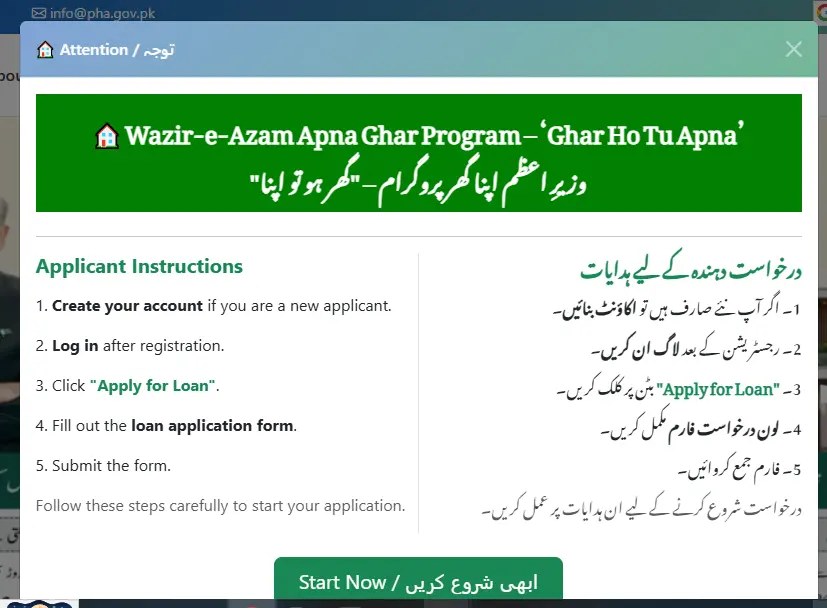
The only official application portal is apnaghar.gov.pk. Be cautious, several lookalike domains have already appeared since the launch. The official portal is hosted on the .gov.pk domain and links from the State Bank of Pakistan's official website.
Step 2: Create Your Account
Click "Register" on the homepage. You will be asked for:
- 13-digit CNIC (no dashes)
- Mobile number registered in your name
- Active email address
- A strong password
The portal may ask you to verify your mobile number or email with a code. Follow the steps shown on screen. If you get stuck, ask your bank or call the PHA UAN 051-111-742-111.
Step 3: Complete the Application Form
Once logged in, fill in the application form. It asks for details such as:
- Personal Details, name, date of birth, marital status, dependents
- Income & Employment, employer/business details, monthly income, other income sources
- Property Requirements, type of financing (purchase/construction), preferred location, estimated property value
- Loan Details, the amount you need (up to Rs 10M) and your preferred bank
Step 4: Upload Required Documents
Upload clear scans of the documents the form asks for. File types and size limits are shown on the portal. Blurry or partial scans can cause delays at verification.
Step 5: Choose Your Bank
All banks, HBFC and microfinance banks can lend under the scheme. Banks with their own scheme pages include:
- Allied Bank Limited (ABL), all branches designated
- HBL (HBL Islamic, Diminishing Musharakah)
- National Bank of Pakistan (NBP)
- House Building Finance Company (HBFC)
- Meezan Bank (Islamic financing)
Other banks may also offer the scheme, so ask at your own bank branch.
Banks must give a decision on a complete application within 15 working days, and the government reviews their disbursement progress regularly.
Step 6: Submit and Track
After submission, save any reference number the portal or bank gives you. The bank you selected will contact you for property valuation and document verification.
Step 7: Approval and Disbursement
Banks have been mandated to complete approvals within 15 working days of receiving a complete application. For loans up to Rs 5 million, the bank can use its in-house valuation. For loans above Rs 5 million, an approved third-party valuer is mandatory.
After approval:
- For purchase: funds disbursed directly to seller
- For construction: funds released in construction-linked tranches as work progresses
Phase 1 Targets and First-Year Plan
The Prime Minister has confirmed concrete first-year targets:
- First-year financing target: 50,000 homes
- First-phase budget allocation: Rs 321 billion
- First batch of cheques: Already distributed at the 30 April launch ceremony in Islamabad
- Coverage: All four provinces, Islamabad, Gilgit-Baltistan and Azad Kashmir
- Personal monthly review: PM Shehbaz Sharif has committed to personally reviewing programme progress every month
The government's stated goal is 500,000 homes over about four years.
PM Apna Ghar (Federal) vs Apni Chhat Apna Ghar (Punjab), Which One Should You Apply For?
This is the question we get most often, because the names are confusingly similar. Here's the clear comparison:
| Feature | PM Apna Ghar Programme (Federal) | Apni Chhat Apna Ghar (Punjab) |
|---|---|---|
| Launched By | PM Shehbaz Sharif | CM Maryam Nawaz |
| Coverage | All Pakistan + GB + AJK | Punjab only |
| Loan Amount | Up to Rs 10M | Rs 1.5M maximum |
| Markup | 5% fixed (10 years), then KIBOR+3% | 0% interest-free |
| Tenure | Up to 20 years | Up to 9 years (older official pages say 7) |
| Income Limit | Verifiable stable income | No fixed income cap published |
| Property Limit | Up to 10 marla / 1,500 sq ft | Up to 5 marla urban / 10 marla rural |
| PMT Score Required | Not required | Not listed in the current eligibility table on acag.punjab.gov.pk (some older pages still say 60 or below) |
| Equity | 10% applicant contribution | None for landowners |
| Best For | Middle-income, salaried/professional | Low-income, asset-poor families |
| Portal | apnaghar.gov.pk | acag.punjab.gov.pk |
Quick rule of thumb: If you live in Punjab and already own a plot of up to 5 marla (urban) or 10 marla (rural), ACAG is better, it's truly interest-free. If you're a salaried professional anywhere in Pakistan looking to buy a 5,10 marla home, the federal PM Apna Ghar Programme is your route.
If you are thinking of applying to both, ask your bank and the ACAG helpline 0800-09100 whether you can hold both loans. This rule has not been published.
Important Updates and Latest News
- 30 April 2026: Programme officially launched at PM House in Islamabad. First cheques distributed to Phase 1 beneficiaries.
- 14 October 2026: Required documents cut from 25 to 5, and banks must decide on a complete application within 15 working days. By this date 75,198 loans worth Rs 448 billion had been approved and about Rs 76 billion disbursed to some 14,000 families.
- July 2026: Non-bank finance companies (NBFCs) were allowed to lend under the programme, alongside banks, Islamic banks, microfinance banks and HBFC.
- 1 April 2026: SBP told banks that the scheme formerly called "Mera Ghar Mera Ashiana" is now officially named "Wazir-e-Azam Apna Ghar Program, Ghar Ho Tu Apna".
- 15 June 2026: SBP allowed overseas Pakistanis holding NICOP or POC to get financing under the scheme.
- 14 September 2026: SBP confirmed that employees of banks, DFIs and microfinance banks cannot benefit from the scheme.
- No prepayment penalty: You can settle the loan early without any extra charges, a rare feature in Pakistani housing finance.
Common Mistakes to Avoid
After studying competitor sites, news reports, and the SBP circular, here are the avoidable mistakes that cause applications to fail:
- Applying through fake websites. Many copycat domains have appeared, only use apnaghar.gov.pk. The .gov.pk extension is the only authentic indicator.
- Submitting blurry document scans. Banks reject these without notice.
- Hiding existing residential property. The scheme is only for first-time home owners, and a false declaration can get your application rejected.
- Not having the 10% equity ready. Without proof of equity in your bank account, your application stalls at verification.
- Applying through someone else's CNIC. The CNIC must match all property and income documents exactly.
- Choosing a bank by name alone. Minimum income, cities and paperwork differ between banks, so compare two or three before selecting.
Frequently Asked Questions
The programme was officially launched by Prime Minister Shehbaz Sharif on 30 April 2026 at PM House in Islamabad, with the first batch of cheques distributed to Phase 1 beneficiaries during the ceremony. The programme is now actively accepting applications.
The maximum loan is Rs 10 million. There are no fixed slabs. The amount you qualify for depends on your income, equity contribution, and the property value being financed.
The markup is 5% fixed for the first 10 years. After year 10, it transitions to 1-year KIBOR + 3%, which is a market-linked rate. The government provides a markup subsidy during the first 10-year period.
Any Pakistani citizen with a valid CNIC, or overseas Pakistani with NICOP or POC, who has no residential property in their name and can show income the bank accepts. Age limits are set by each bank; Allied Bank, for example, asks for 21 to 60, with a maximum age at loan end of 60 for salaried and 65 for self-employed. Employees of banks, DFIs and microfinance banks are not eligible.
Visit apnaghar.gov.pk, register with your CNIC and mobile number, complete the four-section application form, upload required documents, choose a participating bank, and submit. The bank will contact you for verification, and banks must decide on a complete application within 15 working days.
All banks, HBFC and microfinance banks can lend under the scheme. Banks with their own scheme pages include Allied Bank, HBL, Meezan Bank, NBP and HBFC, and other banks may also offer it. Both Islamic and conventional financing options are available. Ask at your branch.
Yes. Since 15 June 2026, SBP allows Non-Resident Pakistanis (NRPs) holding NICOP or POC to get financing under the scheme itself. Banks such as Meezan Bank and Allied Bank list NICOP and POC holders as eligible. Ask your bank which account and documents it needs.
No, the federal scheme is not interest-free, it has a fixed 5% markup for 10 years. The interest-free option is the Punjab Apni Chhat Apna Ghar (ACAG) scheme, which is separate and available only to Punjab residents who own a small plot.
The monthly installment for a Rs 5 million loan at 5% markup over 20 years is Rs 32,998. This is the fixed amount during the first 10 years; the figure may be revised in years 11,20 based on then-prevailing KIBOR rates.
PM Apna Ghar is a federal scheme for all of Pakistan with loans up to Rs 10M at 5% markup. Apni Chhat Apna Ghar is a Punjab-only scheme offering interest-free loans up to Rs 1.5M to low-income families who own a small plot. They are administered by different governments and have different eligibility rules.
No. There is no fee to apply, and bank pages such as Allied Bank state there is no processing cost. Valuation and legal charges may apply at actual cost. Be wary of any agent or website charging a registration fee, this is fraud.
Banks have been mandated by the Prime Minister to complete approvals within 15 working days of receiving a complete application. Delays beyond this are subject to government review.
Yes. The scheme has no prepayment penalty, meaning you can settle the outstanding principal early without any extra charges, a major advantage over conventional housing loans.
You can re-apply once you address the rejection reason (typically incomplete documents, equity shortfall, or credit history issue). Ask the bank for the reason. You may also approach a different participating bank for a fresh review.
Watch Out for Scam Websites
Within hours of the 30 April launch, lookalike websites and Facebook pages started appearing claiming to "register" people for a fee. Do not trust them. The real portal has these characteristics:
- ✅ Domain ends in .gov.pk (specifically
apnaghar.gov.pk) - ✅ Linked from State Bank of Pakistan's official website
- ✅ No registration fee, ever
- ✅ No agent calls demanding processing money
If anyone asks for money to "guarantee" your loan approval, walk away, the programme is administered by the State Bank of Pakistan and the Pakistan Housing Authority Foundation, not by private agents.
Final Word: The Window Is Open Right Now
The PM Apna Ghar Programme is the most accessible federal housing scheme Pakistan has launched in over a decade. The combination of 5% fixed markup, 20-year tenure, 90% financing, and zero application fees genuinely lowers the barrier to homeownership for working-class and middle-class families.
The first-year target is 50,000 houses. With the Prime Minister reviewing progress and banks under mandate to decide complete applications in 15 working days, it pays to have your documents and 10% share ready.
Start your application today at apnaghar.gov.pk, or visit a branch of Allied Bank, HBL, Meezan Bank, NBP, HBFC or another participating bank.
For more guidance on related schemes and step-by-step help, read our other guides:
- Apna Ghar Online Registration 2026, Form, Last Date & Login
- Apna Ghar Loan Calculator, Rs 2.5M to Rs 10M Monthly Payments
- PM Apna Ghar vs Apni Chhat Apna Ghar, Which One Should You Apply For?
Disclaimer: This article is informational only and does not constitute financial advice. The PM Apna Ghar Programme is administered solely by the State Bank of Pakistan and the Pakistan Housing Authority Foundation. Always apply through official channels at apnaghar.gov.pk or at participating bank branches. Information checked on 28 October 2026 against State Bank of Pakistan SH&SFD Circular No. 03 of 2025 and its 2026 circulars and circular letters, Dawn (30 April 2026), The Nation (14 October 2026), and the scheme pages of Allied Bank, HBL, Meezan Bank and NBP.